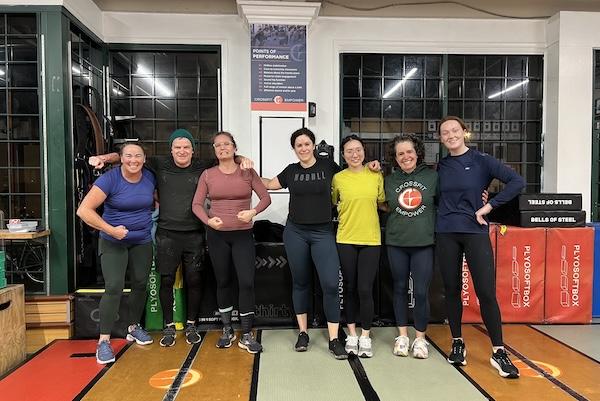
How One Gym Can Safely Train Kids, Parents, and Grandparents — At the Same Time
One of the most common questions we hear at Empower Every Body Fitness is:
“How can people of different ages and abilities all train in the same gym — without someone getting left behind or hurt?”
It’s a fair question. Most gyms are built around a single type of person: young and athletic, already fit, or highly specialized. When life changes — injuries, aging joints, kids entering the picture — the gym often stops fitting.
At Empower, we take a different approach.
Rather than designing workouts for a narrow audience, we design coaching and programs that adapt movements to real humans — across ages, mobility levels, and experience.
That’s what allows families to train under one roof, sometimes across two or three generations, safely and confidently.
This approach is part of what makes Empower a true multi-generational gym, as we explored in Fitness for the Whole Family: One Gym, Every Generation.
Key Takeaways
Empower Every Body Fitness is a multi-generational gym in Vancouver where kids, parents, and grandparents can train safely in the same facility.
Movements like squats, pull-ups, and Olympic lifts are scaled through intelligent coaching — not separate programs or watered-down workouts.
Scaling allows athletes of all ages and abilities to build strength, confidence, and resilience without compromising safety.
Family members can train under one roof while following age-appropriate progressions.
A No Sweat Intro helps determine the safest and most effective starting point for each individual or family.

The Myth: “One Gym Can’t Serve Every Age Well”
Many people assume that:
Kids need one kind of gym
Young adults need another
Adults in their 40s and 50s need to find something “more appropriate”
Older adults need something different again
The reality is that the movements don’t change — the expression of the movement does.
Squatting, pulling, pushing, hinging, lifting, and carrying are human fundamentals. They don't change unless you don't want to be able to get out of a chair or carry your groceries. However, it is true that different age groups may have different concerns or challenges.
That’s where intelligent scaling comes in.
How Scaling Actually Works (Real Examples from the Gym Floor)
Here’s what it looks like in practice — using three very common movements.
1. Squats: Building Strength and Improving Mobility at Any Age
A squat is something we all do in daily life — sitting, standing, getting in and out of chairs.
But not everyone starts in the same place.
Older adults may struggle with mobility or balance and have difficulty reaching full depth
Middle-aged adults may be rebuilding strength after years of sitting or past injuries.
Younger athletes may have mobility but lack control or spatial awareness.
Rather than forcing everyone into the same squat, we adapt the movement, for example:
Ring-supported squats: Holding onto rings provides balance support and allows someone to reach depth safely while maintaining good posture.
Squats to a target: Using a medicine ball or box gives sensory feedback — a clear “this is depth” cue — without guessing or straining.
Progressing toward free squats: As strength and mobility improve, support is reduced.
The result?
Everyone squats well — and at the right level for their body today.
2. Pull-Ups: Built Over Time, Not Overnight
Some people walk in and can do a pull-up on day one. Most don’t — and that’s normal.
Across all ages, we treat pull-ups as a progression, not a pass/fail test.
Ring rows: Often the starting point for older adults and beginners of any age. They build pulling strength with full control.
Banded pull-ups: Elastic bands provide assistance while allowing athletes to practice the full movement pattern.
Jumping pull-ups: Using a box to jump into the top position reinforces coordination and strength through range.
Unassisted pull-ups: Eventually, many people — regardless of age — get there.
The key is patience, coaching, and consistency. Age doesn’t determine success here — programming and progression do.
3. Olympic Lifting (Snatch): Same Intended Stimulus, Different Tools
The snatch is a technical Olympic lift — but the goal behind it is universal: power, coordination, and moving an object from the floor explosively.
Here again we can adjust how we achieve this goal.
Lighter barbells: Stripping weight back to focus on movement mechanics.
Dumbbell snatches: An option where shoulder mobility is limited.
Medicine ball over-the-shoulder throws: For athletes who can't bear weight overhead, med-ball throws preserve the explosive intent without overhead stress.
That’s how someone in their teens, forties, or seventies can all train power safely in the same environment.
When Specialization Makes Sense — Without Leaving the Community
While many families and individuals train together in the same group class, there are times when a more focused approach makes sense.
That’s why Empower offers specialty programs designed around specific ages, goals, or stages of life — without separating people from the broader community.
For example:
Varsity, Junior Varsity, and Homeschool PE help kids and teens build strong movement foundations, coordination, and confidence in a structured, age-appropriate environment.
Lift Over 40 focuses on strength training for women who want to lift well, build muscle, and stay resilient.
Fit Over 40 emphasizes sustainable conditioning, mobility, and smart progressions for long-term health.
Strong Over 60 supports balance, strength, bone density, and confidence — so members can keep doing the things they love outside the gym.
Personal Training offers fully individualized coaching for those who want focused attention, support around injuries or goals, or a customized path — all while staying connected to the Empower community.
Small Group Training blends the personal attention of one-to-one coaching with the motivation and connection of training alongside a partner, friend, or family member.
What’s important is this: these programs don’t pull people out of our community — they deepen their connection to it.
Everyone still sees the same coaches, greets familiar faces, and participates in gym events and shared milestones.
The community stays intact — even as training becomes more personalized.
This flexibility is what allows Empower members to stay for years, even decades. As goals change, life changes, and bodies change, people don’t have to “start over” somewhere else.
They just shift how they train — without losing where they belong.
Start with a Conversation, Not a Workout
If you’re wondering how you — or your family — would fit into this environment, the best first step is a No Sweat Intro.
It’s a relaxed, one-on-one conversation with a coach where we:
Learn about your background
Understand your goals
Recommend the right entry point
No pressure. No obligation. Just clarity.


