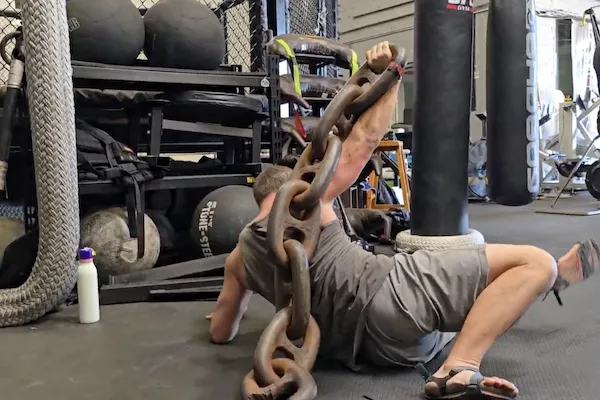
What Is the WeckMethod?
After returning from a weekend at Weck Method Lab in San Diego, I spent 1200+ words trying to explain it. Looking in despair at my tangled summary, I asked AI to give it a shot. What it came up with was a cleaner read but still 1100 words long. So I asked AI to take those two versions and combine them in a brief, blog format — and this is what it came up with:
Most people in mainstream fitness have never heard of WeckMethod — and yet, quietly, professional athletes, strength legends, and top-tier performers are flocking to it. I learned about it the same way: not through marketing, but through word of mouth from people whose results speak louder than programming theory.
After spending a weekend at Weck Labs, I left with a simple conclusion: It works. And it works in ways that are hard to appreciate until you feel them.

The Short Version: What WeckMethod Actually Is
WeckMethod is a training approach that improves rotational strength, contralateral coordination, spinal engine mechanics, athletic rhythm, functional strength, durability against injury, and gait and running mechanics. It’s not a replacement for your training. It’s a method that enhances whatever training you already do.
Why It Works (Even if You’re Skeptical)
1. The Spinal Engine
The spine isn’t just a passive column — it generates and transfers power through rolling, bending, and rotation. WeckMethod trains you to use that instead of fighting it.
2. Reciprocal Movement / Helical Mechanics
Opposing limbs and diagonals work together.
When one shoulder loads, the opposite hip loads — producing a helical (spiral) force.
This is the biomechanical underpinning of sprinting, striking, lifting, and throwing.
3. Coiling Core Training
Their signature idea.
You load one lat/oblique/QL chain while lengthening the other, then switch sides.
This creates elastic recoil and more powerful rotation.
4. Ballistic Rhythm
More bounce, less brace.
Think: crisp, springy, athletic… not slow and rigid.
5. Isometric Neural Priming:
LFE bands, BOSU holds, and isos create immediate strength gains.
A re-emerging practice that was the staple of pre-steroid era strongmen.
The Tools (None Mandatory)
Flow ropes, RMT clubs, propulsors, Sole Steps, LFE bands, BOSU. Tools help, but they’re not essential.

Why You Haven’t Heard of It
Because it’s not a standalone program—it's an upgrade layer to whatever you already train.
Why It Feels Too Simple to Believe
The principles look simple, but the underlying biomechanics are deep.
My Experience at Weck Labs
Short prep sessions created immediate performance boosts. Coiling lit up dormant chains and dramatically improved stability and strength.
Why Athletes Use It
Better sprinting, striking, rotational power, gait mechanics, shoulder health, and durability.
Why Some People Don’t Use It
It can look overly complex, uses unique terminology, and can distract from heavy training if misapplied.
Where It Fits Into CrossFit
CrossFit provides load and simplicity; Weck adds rotation, rhythm, and the spinal engine. Best used for warm-ups and skill prep.
What NOT to Do
Avoid overcomplication, mystical coaching cues, and replacing strength with rope drills.
7 Weck Drills Even Strength Purists Respect
1. Coiling Lunge
2. RopeFlow Underhand Figure-8
3. Slow Dragon Roll
4. Coiling Step-Up
5. RMT/KB Shift + Hinge
6. Arm-Drive Mechanics
7. Cross-Crawl
8. isometrics
Will Weck Method Go Mainstream?
Probably not — it enhances existing systems instead of competing with them. That’s harder to package, but it works exceptionally well for those who use it.
If you want more info, I am happy to share the complete AI 1100 word analysis or my 1200 reflections on Weck Method. Just email “Weck: Tell Me More” to Corey(at)Empowereverybody.com.
